The Best Neighborhoods for Car-Free Living in 2026
6 October 2026
Why Car-Free Living Is Finally a Mainstream Real Estate Decision
For decades, owning a car was treated as a non-negotiable part of adult life in most of the United States and many other countries. That assumption is collapsing. Remote and hybrid work has removed the daily commute for millions of households. Micromobility options have matured from novelty to genuine transportation. Transit agencies in several metros have expanded service frequency and reliability. And a growing number of buyers have simply done the math: a car costs thousands of dollars per year between payments, insurance, fuel, maintenance, parking, and depreciation.But here is the part most articles skip. Car-free living is not a lifestyle you can bolt onto any neighborhood. It is a structural feature of a place. It depends on the intersection of density, land use mix, transit quality, walkability, climate, and the practical realities of how you get groceries, see a doctor, and reach an airport. Choose wrong, and you will end up car-free in theory and car-dependent in practice.
This guide breaks down what actually makes a neighborhood work without a car in 2026, which types of places deliver that, and how to evaluate a specific block before you sign a lease or make an offer.
The Real Criteria for a Car-Free Neighborhood
Most "best neighborhoods" lists rank places by vibe. That is useless for this decision. What matters is function. Here are the criteria that separate a genuinely car-free neighborhood from one that just looks walkable on a postcard.Daily needs within a fifteen-minute walk
The single most important test is whether you can handle an ordinary Tuesday without a vehicle. That means a grocery store, a pharmacy, a bank or credit union, a hardware or general goods store, a post office or shipping option, and at least a few casual restaurants. If any of these require a bus transfer or a thirty-minute walk, the neighborhood is not car-free. It is car-light.Transit that runs when you actually need it
Frequency beats coverage. A stop half a block away that sees one bus per hour is worse than a stop ten minutes away with service every eight minutes. Look at evening and weekend schedules, not just peak commuting hours. A neighborhood that works for a nine-to-five office job but strands you at 10 p.m. on a Saturday is only half functional.Protected infrastructure, not painted lines
A bike lane separated from traffic by a physical barrier, a curb, or a parked-car buffer changes who will actually ride. Paint alone does not. If you plan to rely on a bicycle or e-scooter, check whether the routes you would use are protected and whether they connect to the places you go, not just to a scenic loop.A realistic climate and terrain fit
Walkability scores rarely account for July heat, January ice, or a neighborhood built on a steep hill. These are not dealbreakers, but they change your equipment, your wardrobe, and your tolerance. A flat, mild-climate neighborhood is objectively easier to live in without a car than a hilly one with extreme seasons.Car access when you genuinely need it
The best car-free neighborhoods are not anti-car. They are car-optional. Carshare, rideshare, and traditional rental cars within a short walk give you an escape valve for moving furniture, visiting family, or a weekend trip. A neighborhood without that backup is fragile.
What Changed by 2026
Three shifts have made car-free living more viable than it was even five years ago.First, hybrid work normalized the idea that you do not need to reach a distant office five days a week. That removes the hardest constraint for most households.
Second, micromobility matured. Cargo bikes, e-bikes, and shared scooter systems are now common enough that a household can replace a second car with a bike and a transit pass in many cities.
Third, several cities rezoned for mixed use and reduced parking minimums, which means new housing is increasingly built in places where walking works. This is a slow trend, but it is directionally real.
What has not changed: American car-free living still concentrates in a limited set of neighborhoods, and the best ones share recognizable traits.
The Neighborhood Archetypes That Actually Work
Rather than list specific streets, which age quickly, it helps to understand the archetypes. Most great car-free neighborhoods fall into one of five categories.1. The classic pre-war urban grid
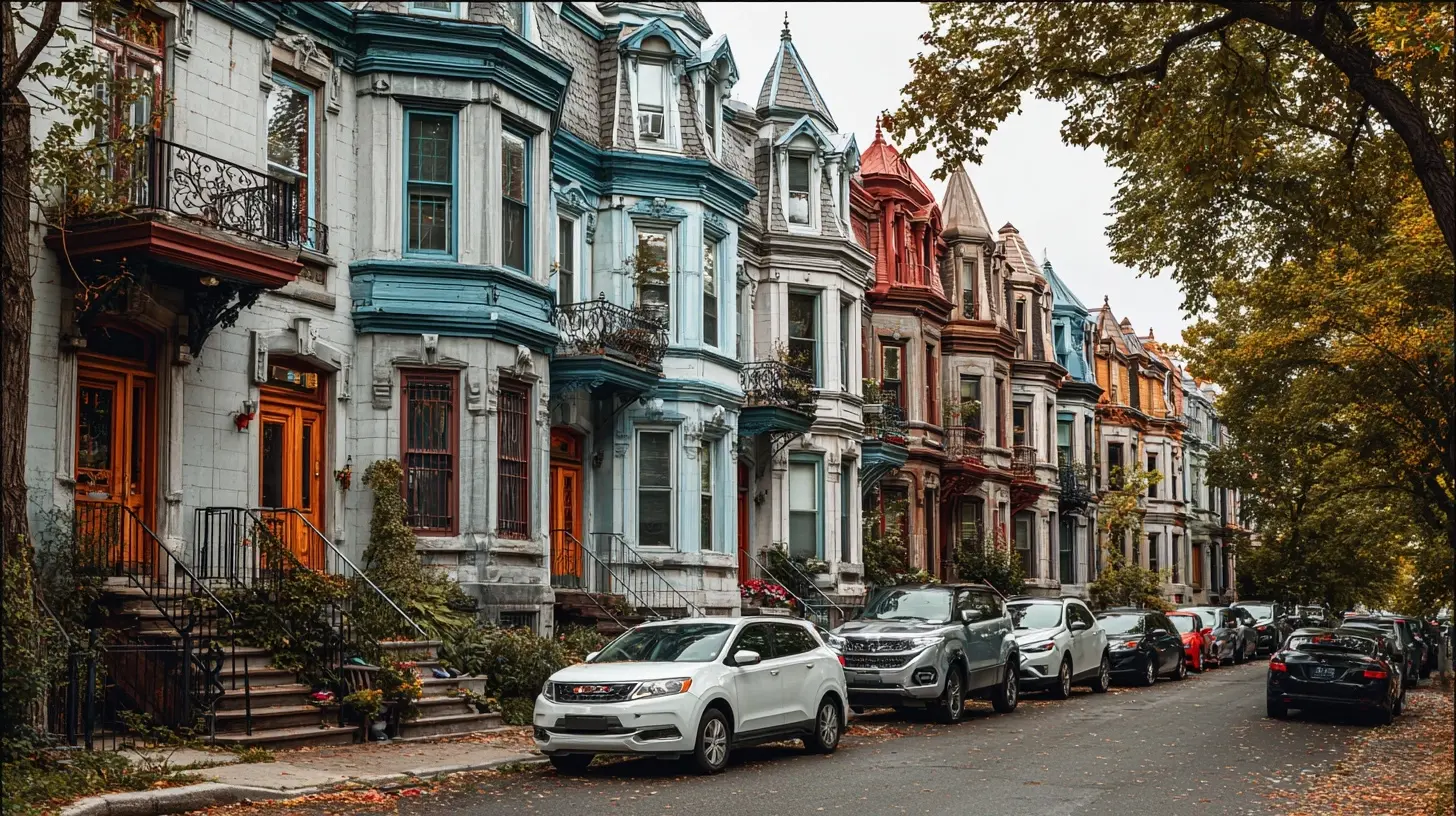
These are neighborhoods built before widespread car ownership, with narrow streets, corner stores, and a dense mix of housing and commerce. Examples exist in nearly every older American city: parts of Boston, Philadelphia, Chicago, San Francisco, and Washington, D.C.Why they work: the physical layout was designed for pedestrians and streetcars. Sidewalks are continuous. Buildings meet the street. Small retail spaces are cheap enough for independent operators.
Trade-offs: housing stock is often older, apartments can be small, and parking is scarce and expensive if you ever want a car. Noise and foot traffic are constants.
2. The transit-oriented new development
These are newer projects built around a rail station or a bus rapid transit line, often with ground-floor retail and structured parking hidden from the street. Examples have appeared around light rail and commuter rail stations in Denver, Seattle, Los Angeles, and Minneapolis.Why they work: transit is the anchor, and the development is designed so that the station is the front door. Amenities are usually new and purpose-built.
Trade-offs: these areas can feel sterile at first, retail takes years to fill in, and rents often carry a premium. If the transit line is new, service reliability and political commitment to funding it are worth scrutinizing.
3. The university-adjacent district
College towns and neighborhoods bordering large universities tend to be walkable by necessity, with frequent buses, cheap food, and a culture that normalizes not driving.Why they work: a built-in population without cars creates demand for pedestrian infrastructure and frequent transit.
Trade-offs: noise, turnover, seasonal crowding, and a housing market skewed toward student rentals. Long-term residents sometimes find the environment exhausting.
4. The small-town main street
A subset of small and mid-sized towns still has a genuine walkable core: a main street with a grocery, a pharmacy, a library, and a few restaurants, surrounded by modest-density housing.Why they work: low cost of entry, low crime in many cases, and a pace that appeals to people leaving big cities.
Trade-offs: transit is often minimal or nonexistent, which means car-free living depends heavily on walking distance and possibly a bike. Medical care and airport access are frequent pain points.
5. The urban village with strong bus rapid transit
Some cities have built high-frequency bus corridors that function like rail at a fraction of the cost. Neighborhoods along these corridors can offer car-free living without rail-adjacent price premiums.Why they work: frequent, all-day service with dedicated lanes can be genuinely reliable.
Trade-offs: bus rapid transit is politically vulnerable. A change in city leadership can downgrade the service, and the neighborhood's car-free viability with it.
A Framework for Evaluating a Specific Neighborhood
When you are standing on a sidewalk trying to decide whether this place will work, run this sequence.1. Map your actual weekly destinations: work if applicable, grocery, gym, medical, place of worship, social spots, airport.
2. Check transit frequency at the times you would travel, not just at noon on a Tuesday.
3. Walk the route to the grocery store at rush hour and again after dark.
4. Test the bike route, if you plan to ride, on a weekday.
5. Identify your car backup: nearest carshare pod, rental agency, and rideshare wait times.
6. Talk to two or three residents about what breaks. Ask specifically about winter, late nights, and weekends.
7. Price the trade-off honestly: higher rent and no car versus lower rent and a car payment.
That last step is where most people fool themselves. A car-free neighborhood with a $400 monthly rent premium may still save money, but only if you genuinely give up the vehicle. Keeping a car "just in case" in an expensive walkable neighborhood is the worst of both worlds.
Common Mistakes and Misconceptions
Mistake: Trusting a walk score alone. Walk scores measure proximity to amenities, not the quality of the walking experience. A busy stroad with a high walk score can be miserable and dangerous to cross.Mistake: Assuming a car-free neighborhood means no cars. It does not. It means you personally do not need one. Traffic, delivery vehicles, and neighbors' cars still exist.
Misconception: Car-free living only works in big coastal cities. Not true. Mid-sized cities and college towns often deliver a better cost-to-convenience ratio.
Misconception: You need to sell your car immediately. A staged transition, keeping the car for six months while you test the neighborhood, is usually smarter than a dramatic leap.
Mistake: Ignoring the second-order costs. Groceries at a walkable corner store often cost more than at a suburban supermarket. Delivery fees add up. Budget for these.
The Trade-Offs Nobody Advertises
Car-free living trades one set of problems for another. You gain money, health, and often a stronger sense of community. You lose spontaneity for certain kinds of trips, flexibility during emergencies, and the ability to carry large or bulky items without planning.Weather becomes a real factor in a way it never was when you drove everywhere. So does illness or injury. If you break a leg, can you still get groceries? The best car-free neighborhoods have delivery infrastructure and neighbors who help. The worst leave you stranded.
There is also a social dimension. In many car-dependent places, not driving carries a stigma or at least an inconvenience for friends who expect you to meet them somewhere. In genuinely walkable neighborhoods, this fades, because everyone is navigating the same way.
How to Decide If This Is Right for You
Car-free living suits households that value time and money over flexibility, that live and work or recreate within a compact area, and that are comfortable with planning. It suits remote workers, students, retirees in good health, and young professionals in transit-rich cities.It suits fewer people who have young children in multiple schools, who care for elderly relatives across town, who work in scattered locations, or who have mobility limitations that make walking and transit physically difficult. That is not a judgment. It is a fit question.
The honest answer for many households is car-light rather than car-free: one vehicle instead of two, used sparingly. That is often the smartest financial and practical move, and it preserves most of the benefits.
Final Thoughts
The best car-free neighborhood in 2026 is not a famous one. It is the one where your specific life fits without a car. That means checking transit frequency at 9 p.m., walking the grocery route in bad weather, and confirming that a carshare exists for the exceptions.Do that work before you move, and car-free living stops being an idealistic experiment. It becomes an ordinary, durable, and often cheaper way to live.
all images in this post were generated using AI tools
Category:
Neighborhood GuidesAuthor:

Melanie Kirkland